


 26 / 52

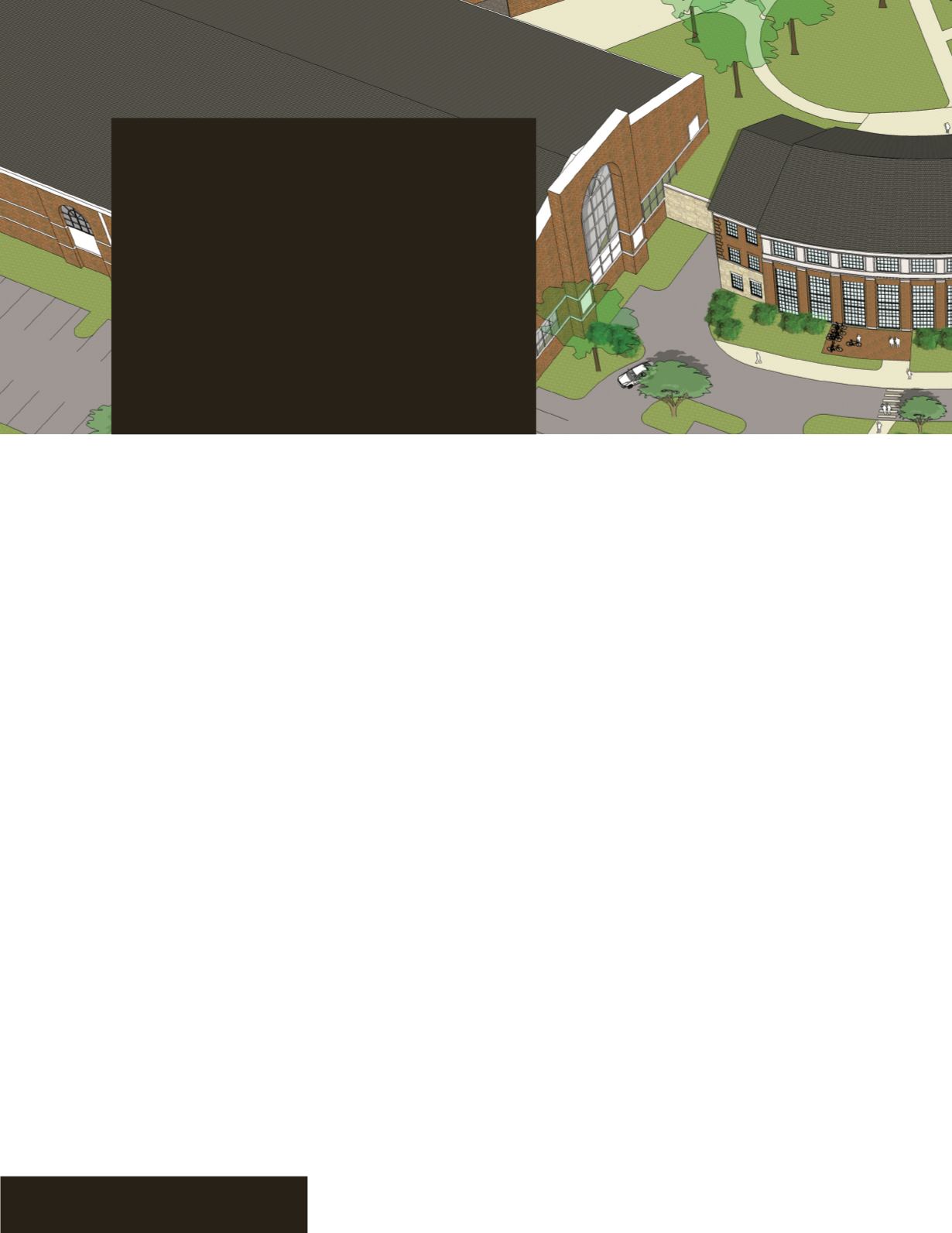
A mile and a half away, the Pennsylvania College of Technology
had recently constructed a new grand entrance of their own near
the Maynard Street exit of Interstate 180, and Shangraw saw the
immediate appeal.
For years, the arrival sequence to Lycoming’s campus has
remained a convoluted, inelegant and unwelcoming process ending
at the Drum Admissions House on the north end of the campus.
Even today, prospective students, parents and other visitors negotiate
a labyrinthine circuit of roundabouts and one-way streets before they
are guided up Market Street to parking lots at the dead-end of Little
League Boulevard. From there, they hike up to Lamade Gymnasium
and down College Place to the historic but undersized Drum House.
This sequence effectively functions as an obstacle for those who
don’t yet know Lycoming. Admitted student surveys continue to
indicate that Lycoming’s campus surroundings are held in lower
regard than those of peer institutions, and are often cited as a
major reason why respondents have chosen to enroll elsewhere. (Of
course, it is impossible to know how many other would-be prospects
simply moved on, without once setting foot on the beautiful Fultz
Quadrangle, or hearing from an admissions counselor about
research and travel opportunities, or seeing first-hand the Lycoming
faculty’s commitment to individual student attention.)
Meanwhile, over the ensuing decades, those who do know
the College had watched its campus become more fortress-like,
particularly at the southern and western edges of campus. There, in
Williamsport’s oldest neighborhood, the sizeable pockets of neglect
and decay — and ultimately large swaths of demolition — had
created a virtual no-man’s land between the campus community and
the downtown activity west of Market Street.
But in his first few weeks as president, Dr. Kent Trachte asked
a simple and logical question about campus visitors that manifestly
underscored Shangraw’s vision: “Which way does their GPS send them?”
“Probably up Basin Street” came the answer, and so Trachte
reasoned that, whether we liked it or not, Basin Street was our
entrance. So maybe the College needed to consider treating it as such.
THE NEW “OLD CITY”
In 2008, Williamsport played host to the
Pennsylvania Governor’s Awards for the Arts
— among the honorees was Lycoming College
creative writing professor Sascha Feinstein
as “Artist of the Year” — and new hotels and
restaurants, art galleries and loft apartments
were springing up.
City government and county planners needed
to provide a growth area for the resurging
success of downtown Williamsport. The
following year, local government rezoned a large
section of the downtown east of Market Street
and south of Lycoming’s campus as “Central
Business District” to match the burgeoning
west end, with the added goal of relocating light
industrial and warehousing activities to more
appropriate parts of the city.
A zoning map amendment alone would
not be enough to affect real change, however.
The process begged for leadership and
partnership, thoughtful study, and private
capital to match any investment in public
infrastructure.
D
AR
decade ago, the late board chairman
emeritus Bob Shangraw ’58, H’04
stood at the corner of Basin Street and
that glorified alleyway between Third and
Fourth Streets known as Willow Street,
telling anyone who would listen that
“this should be the grand entrance to
Lycoming College.”
A
A VISION
TRANSFORM
OUR CAMPUS
26
C AM PA I G N