


 23 / 52

E
CLOUDS
It was dark when Dr. Tim Merkel ’64 left for
the summit on Feb. 28, and the light from the
headlamps ahead of him looked like a stairway
to heaven.
For a 74-year-old man who had overcome
a quintuple bypass surgery in 1996, it was an
emotional experience as he reached the summit
of Mount Kilimanjaro, the tallest mountain in
Africa, at 19,341 feet above sea level.
On the start of his sixth day on the mountain,
he left camp at midnight with his son, David,
and son-in-law, Chris Peak, along with his
guides at Alpine Ascents International, to reach
the summit. For two days before that, the crew
would climb and retreat from above the clouds,
trying to acclimatize to the atmosphere.
During the fifth day on the mountain, when
they were in their fourth different climate zone
of the trip — an alpine desert — they stopped
at 16,000 feet, made camp and were resting by 4
p.m. They woke up at 11 p.m. and at midnight,
left for the summit, six miles away with two liters
of water in each of their packs.
The weather was cool, about 15 degrees, and it
was dark. Headlamps were all that you could use
to stay on path.
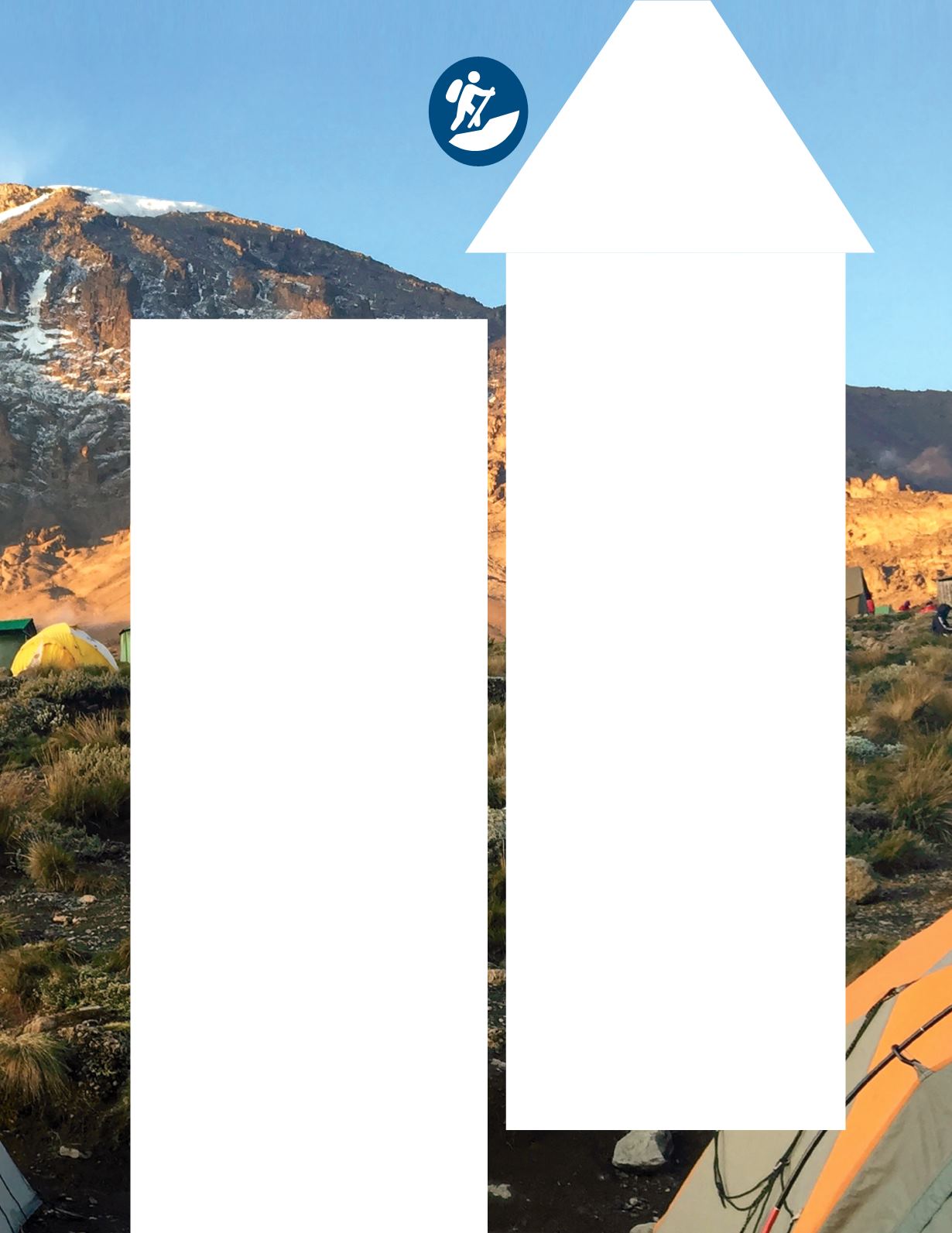
“When you reach the top, it is absolutely
gorgeous,” Merkel said. “We have some photos
of the sun coming up over clouds and it is
incredibly beautiful. You can see glaciers at the
top of the mountain and when you see how large
they are, it is mind-boggling.”
The world traveler has been a part of the
aerospace and automotive industry for more than
40 years. He was at the canonization of Mother
Teresa on Sept. 4, and is in the midst of starting
a new company, Brake Pad Waste Collection
Systems, Inc.
But, even with all of that on his plate, it was
the summit of Mount Kilimanjaro that Merkel
says was one of the toughest things he has ever
done. A trip through five climate zones —
rain forest, heath, moorland, alpine desert
and arctic — the 39-mile hike is unlike any
other on the planet.
“It got more exciting as we went along,”
Merkel said. “It was a terrific process. There
is so much to learn on that mountain. The
temperature change goes from 70 degrees to
below zero.”
In other words, there was nothing typical
about the hike. The plan for the trip was
eight years in the making, when Merkel and
his wife, Theresa, first visited Tanzania on a
missionary trip with a Lutheran Church to
support schools in the East African country.
After the mission work was completed,
Merkel and his wife did a week-long safari
and on the final day, they visited Kilimanjaro
National Park for the first time.
The visit left an impression on him and in
2015, he signed his son and son-in-law on to
finally make the trip.
“We started to plan this and it got more
exciting as we went along,” Merkel said. “It
was a terrific process.”
The night before they left their hotel
outside Kilimanjaro National Park, every
piece of equipment they would need was laid
out on floor. It was catalogued and packed,
and the next morning, they were off. Even on
a mountain with only a 65 percent success
rate of reaching the summit, at no time
did Merkel feel like he couldn’t make it. Of
course, maybe that is because he didn’t have
the time to think about it.
“I had to think about what was next,”
Merkel said. “Every night, we were briefed
on what the next day would be in detail. I
was exhausted and it’s challenging. If I had
more time to think, I would’ve taken more
photos.”
23
www.lycoming.eduF E AT U R E