


 29 / 52

In 2013, Lycoming College partnered
with city and county government to
commission a redevelopment study
called the Old City Revitalization Plan,
and together assembled a task force of
local business owners and developers to
guide the process. Consultants Thomas
Point Associates and Urban Research
Development Corporation conducted
community surveys, focus groups and
public meetings, and the resulting
recommendations were adopted by the city
in 2015.
While the plan identified five particular
initiatives within the study area, the
primary strategy specifically called for the
creation of a strong connection between
the Basin Street exit of Interstate 180 and
the Lycoming College campus edge at the
north end of Basin Street.
And the plan further called for partners
“to make public investments in order to
stimulate private investment.”
MOMENTUM
By the close of 2016, the collaboration
had already notched some early and
significant wins, and, in just the past
month, it has brought aboard two vital
new partners: The Commonwealth of
Pennsylvania and the First Community
Foundation Partnership of Pennsylvania
(FCFP).
Even as architectural plans are being
refined, the infrastructure development
needed to support the vision just received
its first major infusion: In early December
2016, state officials Sen. Gene Yaw ’70 and
Rep. Jeff Wheeland announced a grant
of $777,395 for the Gateway Project from
the Commonwealth Financing Authority
under the Multimodal Transportation
Fund. In large part due to its connectivity
to other Williamsport revitalization
projects, officials said the project made a
compelling case for qualifying for a sizable
award under this program.
“The connection between Lycoming
College and the business community
MIXED-USE BUILDINGS
With the Summer 2016 acquisition
and demolition of a worn-out,
vinyl-sided triplex — a process
complicated by the fact that each
unit was owned by a separate
absentee landlord — the College now
owns all of the land along the west
side of Basin Street.
Here, Lycoming’s campus
planning consultants Derck & Edson
have envisioned the construction of
two three-story, mixed-use buildings
(residential units above retail and
commercial spaces) to create a
venue for the same types of “college
town” amenities that thrive on the
peripheries of campuses across the
country.
And similar to those examples,
the College envisions a partnership
with a private developer, and has
already received early interest
from several with successful track
records in this same space. One
benefit of such an arrangement is
that the construction of this project
can occur independently of any
on-campus work, and beyond the
required roadway infrastructure
work, projects do not need to be
phased in a particular order.
Research that includes two
independent market studies — one
published by Lycoming’s Center
for the Study of Community and
the Economy in December 2014 —
suggests a litany of exciting ideas
for a tenant mix at that location,
including an Indian restaurant, a
neighborhood health center and
perhaps even relocating the campus
bookstore to a more prominent
location. These studies have also
identified an increased desire on
the part of young professionals and
empty-nesters alike to reside in
revitalized downtown environments,
with an added value being the
cachet of a college neighborhood. —
Patrick Marty
The connection between Lycoming College and the business
community will be a great step in the entire reshaping of the area
,,
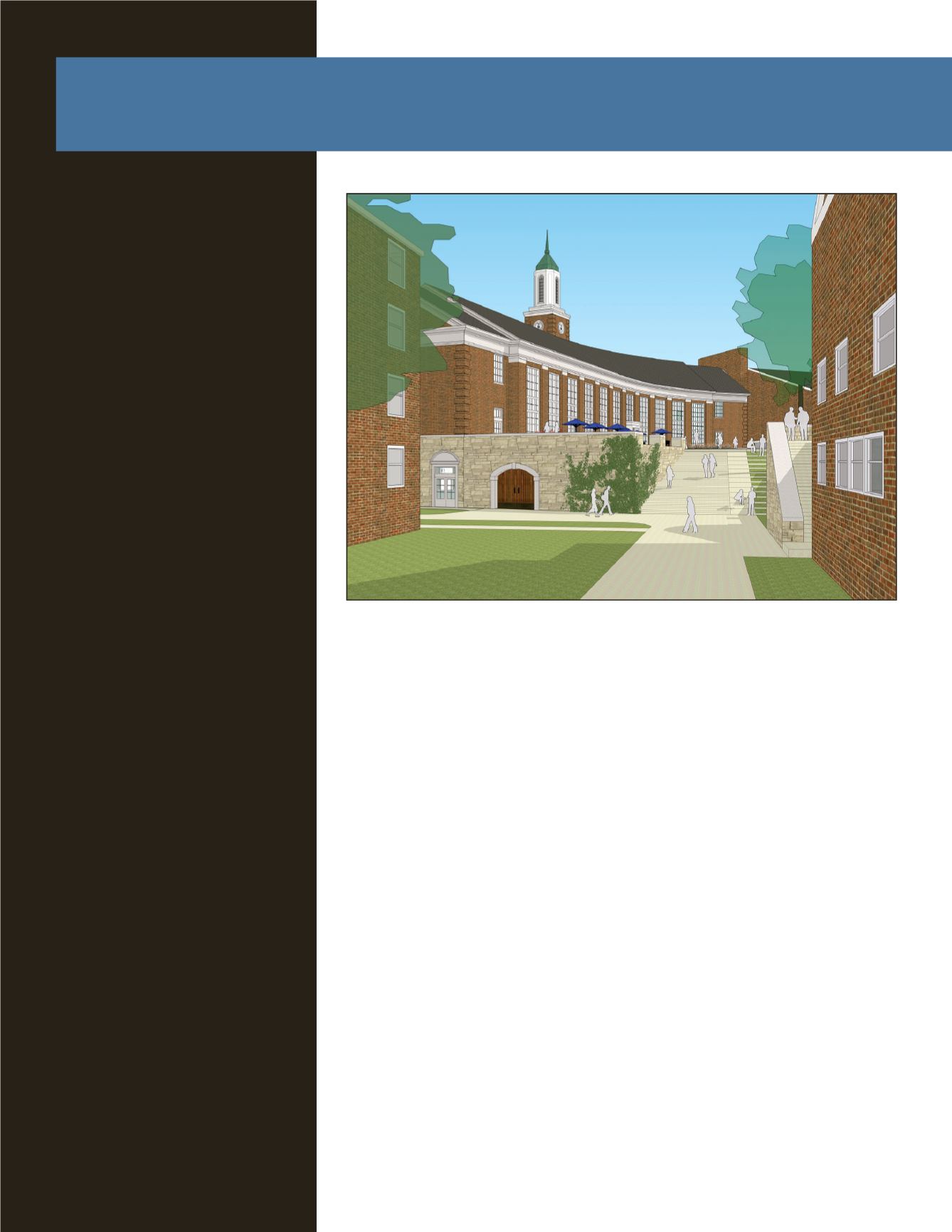
Gateway building project view from John Long Hall
29
www.lycoming.eduC AM PA I G N