


 17 / 52

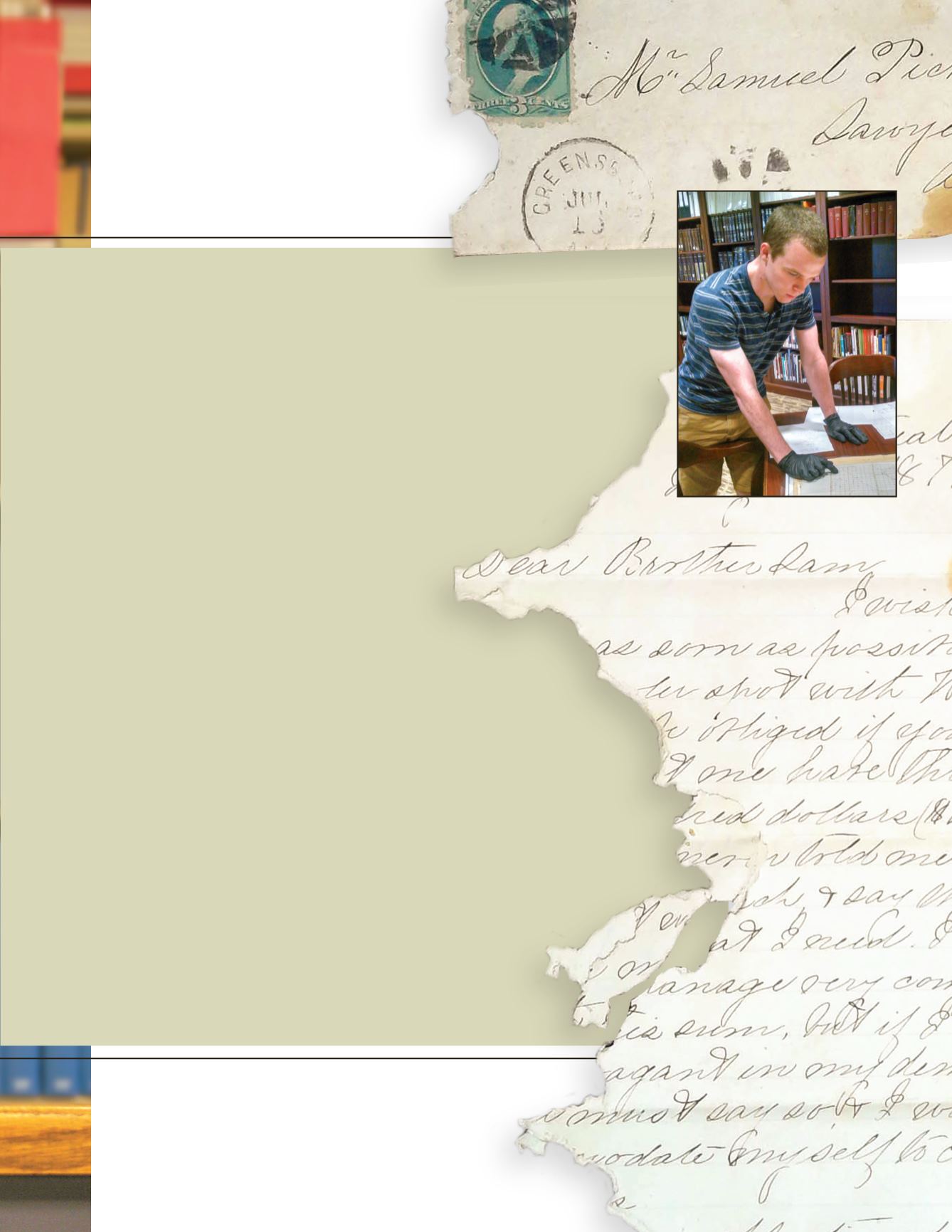
An envelope and letter fragment from Helen Pickens
to brother-in-law Samuel Pickens, July 12, 1871.
Not all letters survived intact.
(The Doy Leale McCall Papers, The Doy Leale
McCall Rare Book and Manuscript Library,
University of South Alabama.)
Under a grant supported by the Mellon Foundation to encourage faculty-student research
collaborations in the humanities here at Lycoming, Jacob Quasius ’18 joined the project in June to
assist with the initial phase of research. In early July, we traveled to the University of South Alabama
in Mobile to explore the archival collection. Together, we digitized more than 8,000 pages of family
correspondence, diaries and legal documents spanning from 1850 to 1878. Returning to Lycoming,
we uploaded the documents to a digital collaborative workspace for transcription, annotation
and tagging.
To coordinate the work of multiple researchers, we constructed a topic-indexed
correspondence database to organize and quickly access sources reviewed and annotated
by team members. The database also permits experimentation with data visualizations
that characterize the evidence in ways not immediately apparent to an individual
scholar. By connecting geolocation markers and topic tags to documents,
we can map the frequent travels of the Pickens family members
and track the varying frequency with which specific topics
were discussed in correspondence. These digital tools facilitate
discussions of the sources that yield a fuller, more nuanced
analysis.
The Pickens family collection is vast, containing nearly 7,000 letters and
100 personal diaries, making it ideal for collaborative research. Quasius’s assistance
this summer enabled us to organize a large body of evidence quickly. In exchange, he
gained valuable experience with advanced research and an opportunity to make intellectual
contributions to the project. For example, Quasius uncovered evidence suggesting that the
mother’s frequent health complaints may have resulted from multiple sclerosis, casting family
interactions in a new light.
Already a seasoned disability rights advocate, Quasius benefitted from this project by acquiring
in-depth research and analysis experience — skills that will aid him when he pursues graduate
studies in public policy, especially if he continues on to law school. Exposure to the challenges of
managing and maintaining large-scale projects will also put him at an advantage in his future career
in public service. Over the next three years, we hope to bring additional student researchers into the
project, all of whose contributions will be acknowledged in the final book.
Given public interest in both the Civil War and the Ku Klux Klan, we believe the book
will foster productive public discussion of terrorist violence and the enduring
challenge to forming a more equal society. We also hope to demonstrate the
quality of scholarship that can be achieved through collaboration between
faculty and student researchers across liberal arts institutions.
Jacob Quasius ’18
17
www.lycoming.eduF E AT U R E