


 43 / 58

S
ubterranean
B
y
B
ridget
B
ellmore
You found black-eyed Susans pressed
within the flecks of my irises, as if
they’d been fossilized, and I, rising
from the earth to take on life,
carried them with me, used them
to see.
If I could have created you, I would
have sculpted you from the clay I dug
from the stream behind my house,
pleased to be the one who molded
the muscles along your spine, who shaped
them to fill my hands perfectly whenever
I’d hold you.
Is it so wrong to doubt
our mothers and search for our conception
between layers in the ground, believing
the evidence that the matter of our souls
and selves were formed among impressions
of previously flourishing things?
READING
PROGRAM
Alumni
The Bellmore poem was the winning entry
for poetry in the most recent issue of The
Tributary.
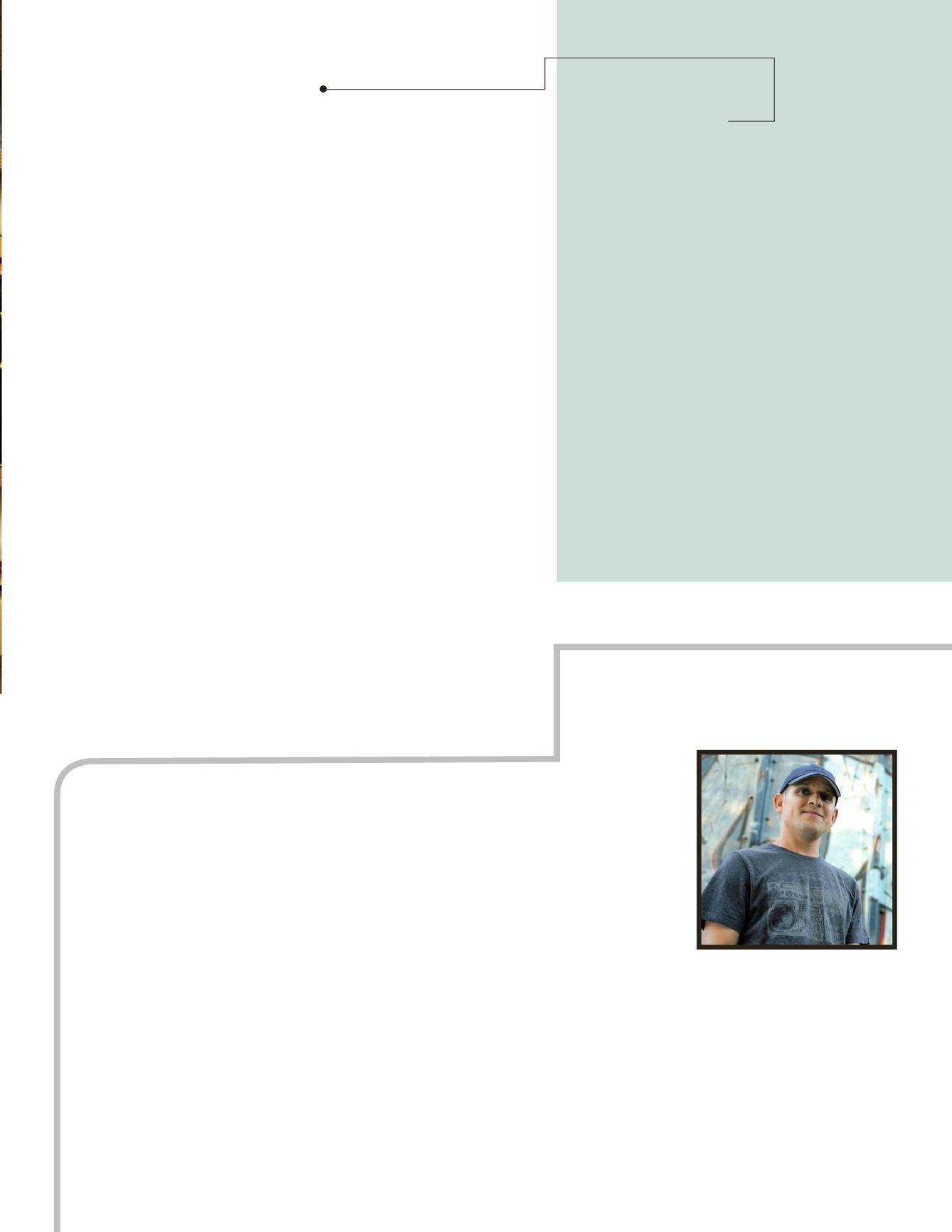
Stephen Cramer
’97
Language is more than just words for poet Stephen Cramer ’97. It inhabits the body.
“I fell in love with poetry at the age of 14, when I saw a video of Stanley Kunitz reading
his poem ‘The Round.’ I was amazed at how incantatory it was, and I played it until I
hadn’t just memorized it, but felt as if it were part of my musculature.”
Cramer’s work often combines gritty imagery with rhythms that are palpable, as in
“What We Do,” from his book “Tongue and Groove”: “He’s drumming/a rim full of dents,
angled/facets that pull to themselves/all the sun they can bear.” Pulitzer Prize-winning
poet Yusef Komunyakaa has described Cramer’s work as giving “a map of sound, where the
pastoral and the urban inform each other, and the only level and plumb line that matters is the heart.”
Last year, Cramer released his third volume of poetry, “From the Hip” (Wind Ridge Books, 2014), a series that merges the
rigor of the sonnet form with the urgent cadences of hip-hop. “I am addicted to sonnets these days,” Cramer confessed. “The
form takes you out of your mental agenda. When you sit down to write, the sonnet is going to push you around.”
A prolific writer who teaches at the University of Vermont, Cramer is a four-time Pushcart Prize nominee, and has
published dozens of his poems in periodicals and literary journals, including The American Poetry Review and The Harvard
Review. He recently completed a fourth collection of poems, “Bone Music,” and already has another book in development,
a culinary series entitled “A Little Thyme and a Pinch of Rhyme,” poetic recipes where the ingredients are haiku and the
instructions sonnets. “Poets typically have two masters: reason, so the poems make sense, and musicality,” explained Cramer.
“These poems have to taste good too.”
OUTCOMES
One of the jewels of
Lycoming’s creative writing
program, the Himes/Sweeney
Visiting Scholar in Creative
Writing Series, brings some of the top writers in the country to the
college to share their work and insights with students and the Lycoming
community.
Originally dubbed simply the Reading Series, its longevity has now
been guaranteed by the generous endowment of alumna Diane Himes-
Sweeney ’63. Past visitors in the series include two of the nation’s former
poets laureate, Philip Levine and Billy Collins, as well as winners of
almost any American literary prize you could name, including the
National Book Award, the Pulitzer Prize, the O. Henry Award, and many
others. “It’s fabulous how many sensational writers we have been able to
bring to Lycoming with this program,” said Prof. Sascha Feinstein, who
directs the series. “At first I had to call in all my favors, but now the word
has gotten out and writers really enjoy coming here.”
Because of opportunities like this and the structure of the creative
writing program as a whole, undergraduate students at Lycoming
essentially get graduate-level seminar and critique experiences. “When
our students go to MFA writing programs, they regularly tell me how
much better prepared they are for it than counterparts from other
schools, who are often taken aback by the intensity of things at the
graduate level,” Feinstein noted.
The educational benefits of the Himes/Sweeney series for Lycoming
students go beyond witnessing great writers presenting their work. “Our
students get to work directly in small groups with artists at the peak
of their craft,” Feinstein said. “Imagine ten of our students sitting in a
workshop with C.K. Williams. They will never forget that. Ever.”
43
www.lycoming.eduF E AT U R E S