



 33 / 48

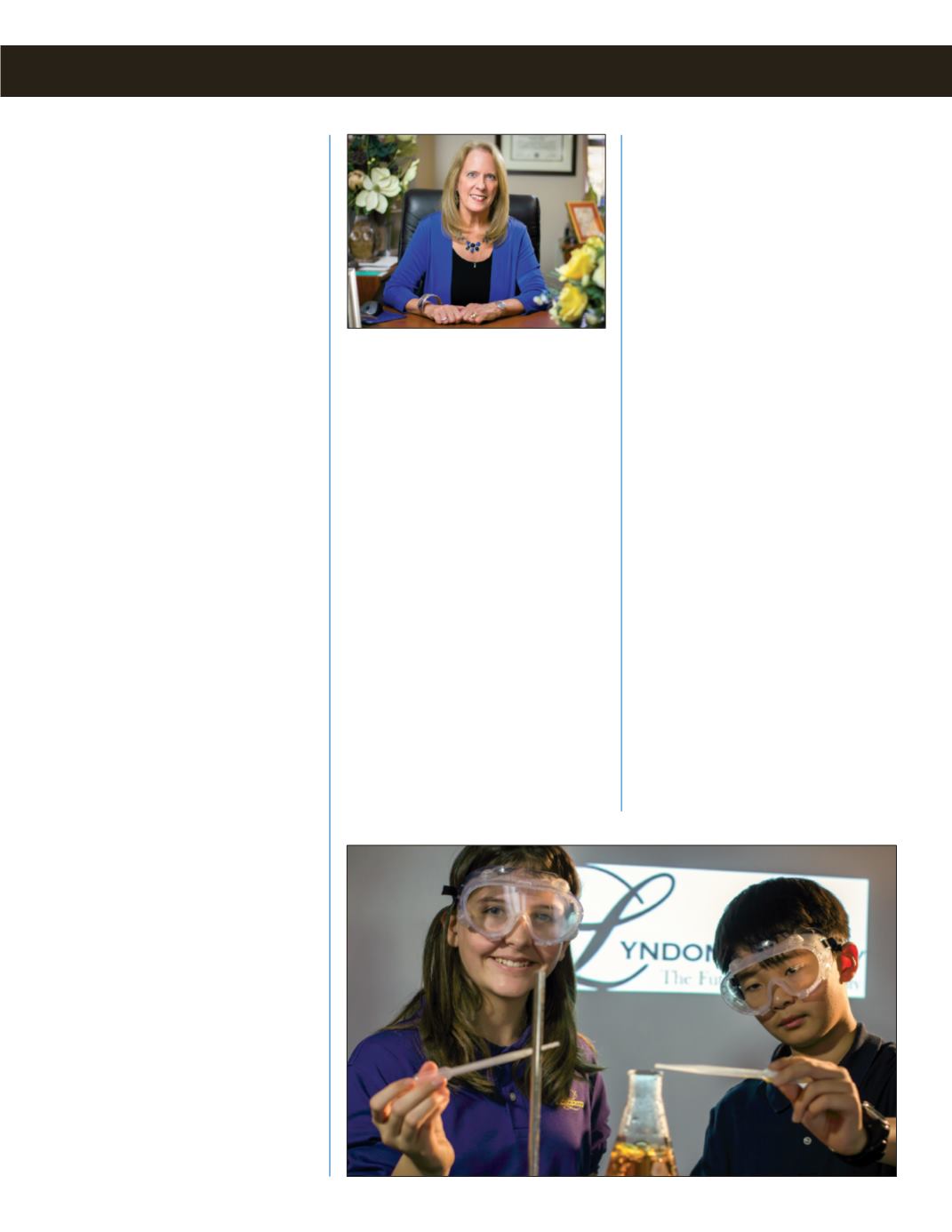
Linda Murdock ’69
33
www.lycoming.eduF E AT U R E S
give these students a competitive edge in
a global society. What if an employer says
they need someone to work in China? For
our students, that would be no problem.”
There are elements of learning that
can be delayed when children take on
more than a single language. “Some
things are slowed down, I won’t deny it,
but once balanced, this is better for the
students,” Murdock said. Experts seem
to generally agree, saying the delays are
overstated and outweighed by the benefits
of bilingual study. For instance, according
to the Cornell Language Acquisition Lab,
while bilingual children may be a little
slower to reach certain benchmarks, they
quickly reach par with children learning a
single language. CLAL also cites a recent
finding that “bilingualism enhances
the development of executive attention
and facilitates superior performance in
bilinguals as compared to monolingual
counterparts.”
Other key aspects of the curriculum are
ownership and stewardship, qualities that
are inculcated early in the children. “We
teach them to take care of the school, to
participate in that. We also look for ways
the students themselves can do something
for those in need, rather than having the
parents do it, for example,” Murdock said.
On a recent trip to Washington, D.C.,
Lyndon students were invited to take part
in a solemn wreath-laying ceremony at
the Tomb of the Unknowns in Arlington
National Cemetery. “I never even would
have had that on my dream list,” Murdock
said. “It was an incredible honor.”
On a frigid and damp November
afternoon, four Lyndon students spent
a half hour rehearsing their parts. They
were then guided by an honor guard as
they processed to the tomb in tandem
and placed the wreath. A video of the
ceremony can be seen on YouTube.
“Those kids felt it,” Murdock said. “They
understood the implications of what they
were doing: the privilege of representing
their own school, the commitment to their
country that it represented and what all
those men and women had done.”
Originally from Binghamton, Ny,
Murdock speaks well of her own
educational opportunities and is keen
on her time at Lycoming. “I loved it
and I’m very proud of it. It provided me
everything I needed to accomplish what
I have done, and I am grateful for that,”
she said. “It was a unique experience, and
I wish my professors were still around so
I could say thank you. We didn’t say that
enough back then.”
She seemed destined for a career in
education. “I was always one of the kids in
the neighborhood that rounded up all the
other kids to do things, or I would teach
Sunday school classes,” she said “It was
the children –– that spark you see in their
eye when something happens. That drew
me in and kept me with it.”
After graduating from Lycoming,
Murdock taught in public and private
schools for three decades before moving
south, where she began her first school
in Bradenton, Fla., home to elite training
facilities for young, world-class athletes in
sports like tennis and soccer. A colleague
invited her to develop a school that would
meet their needs. “It was unique. We were
open from 7:30 in the morning until 9
p.m. It ran more college style,” she said.
Among her students were five-time
grand slam tennis champion Maria
Sharapova and Michael Parkhurst, a
defender who has accumulated 25 caps
for the United States men’s national
soccer team and is lately of the
Columbus Crew.
“There was nothing like having
students from, say, South America,
France and the U.S. together in a world
history class. They had all learned
different histories,” Murdock said. “It
was fascinating and made for some
lively conversations. I remember when
things got heated once saying that if they
couldn’t get along, there was no hope
for us; they had to learn how to work
together.”
As to her own work, Murdock needs
no exhortation. “This isn’t a job where
you just shut down when you go home,”
she said. “The children are constantly
on your mind and I feel a tremendous
obligation to make sure they are ready
for the future. I get up in the morning and
think, if I am not doing it, who will?”
•
“I want these children to be ready for whatever the world throws at them.”