



 7 / 48

7
www.lycoming.eduT H E CO L L E G E
oing abroad gives
anthropology students the
opportunity to conduct full
ethnographic research since they can
live in an environment long enough
to fully experience the local culture.
While study abroad has always been
a priority for Lycoming College, the
field has seen a major push within the
past year.
“We are giving students the
opportunity to go abroad and conduct
research at the undergraduate level,
which puts them ahead for graduate school,” said Dr. Ryan
Adams, assistant professor of anthropology.
Matthew Amendolara ’15 from Bristol, Rhode Island,
made a return visit to Quetzaltenango, Guatemala. During
his first trip there, he was intrigued by a mural that portrayed
images of the 30-year Guatemalan Civil War and genocide
that ended the 1990s. Seeing the image inspired him to
return to Guatemala to investigate the effects of globalization
and resistance theory on the street art that can be found
throughout the city of Quetzaltenango.
Amendolara spent his days learning Spanish, attending
speeches and galleries throughout town and, most
importantly, interacting with the local people to gain
perspective on their culture. While the Civil War is over,
it is still a sensitive topic within the culture and he quickly
discovered the heightened culture of fear that citizens are
currently living in.
“Learning about these ideas and seeing it are two totally
different things,” said Amendolara. “It ended up being
extremely rewarding because I taught myself that I could do
this on my own in a foreign land and come away with not only
an awesome experience, but also a really interesting research
project.”
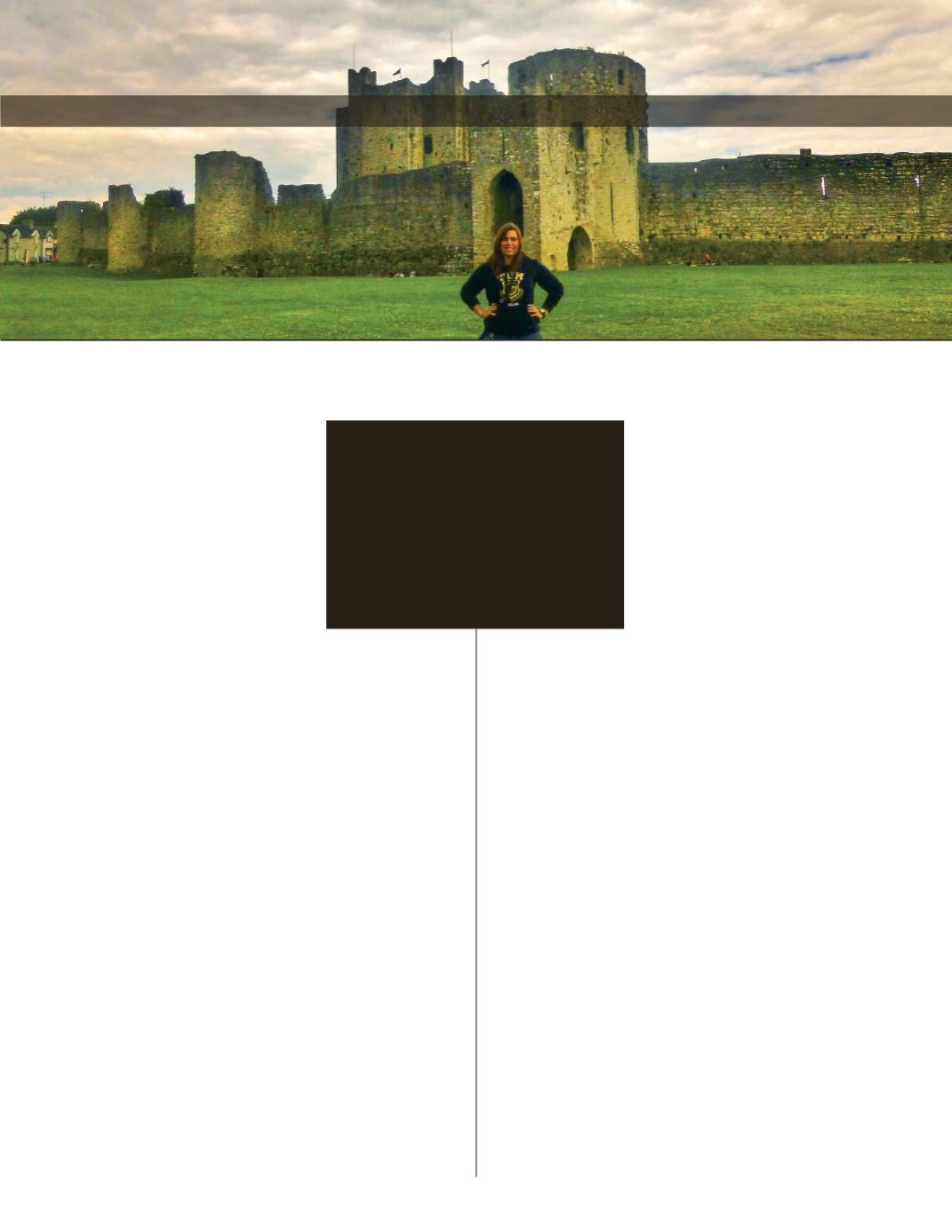
Michelle Neifert ’15 from
Orwigsburg, Pennsylvania combined
her interests in archaeology and
anthropology when she traveled to
Trim, Ireland. She originally planned
the trip as an archaeological dig in
a medieval town, but later decided
that she would also investigate the
close working relationship that Trim
locals had developed with the local
archaeological site.
“The archaeological site is at the
heart of the town and the community
has really created an identity around promoting knowledge
and involvement with the site,” said Neifert. “Pubs are the main
place of interaction in Ireland, so I spent a lot of my free time
there just meeting new people and talking to them about the
community.”
Neifert was not the only student to combine her archaeology
and anthropology interests. Brigid Clark ’15 from Wyndmoor,
Pennsylvania spent her summer in Cyprus, an island that
is divided between Turkish and Greek heritage, where
many different citizens have been uprooted in the midst of
the conflict. With the relocation and identity shift that has
occurred, people have reconstructed their identities. Clark
focused on the archaeology site and its influence on the locals.
She spent her days observing how the locals interacted with
one another and the site itself. Although she faced several
language barriers, Clark studied the reactions that people had to
both the physical site and the finds from the site. “What I found
the most astounding was the trouble the locals had accepting
the non-Greek artifacts that were found at the site,” said Clark.
“These artifacts are also a part of their history, but if it didn’t
support their identity beliefs, it wasn’t important to them.”
Both Clark and Amendolara were invited to present their
research findings at the Society for Applied Anthropology
(SfAA) Conference in March.
•
R E S E A R C H A R O U N D T H E W O R L D
Students complete capstone project abroad
“We are giving students the
opportunity to go abroad and
conduct research
at the undergraduate level,
which puts them ahead
for graduate school”
G